
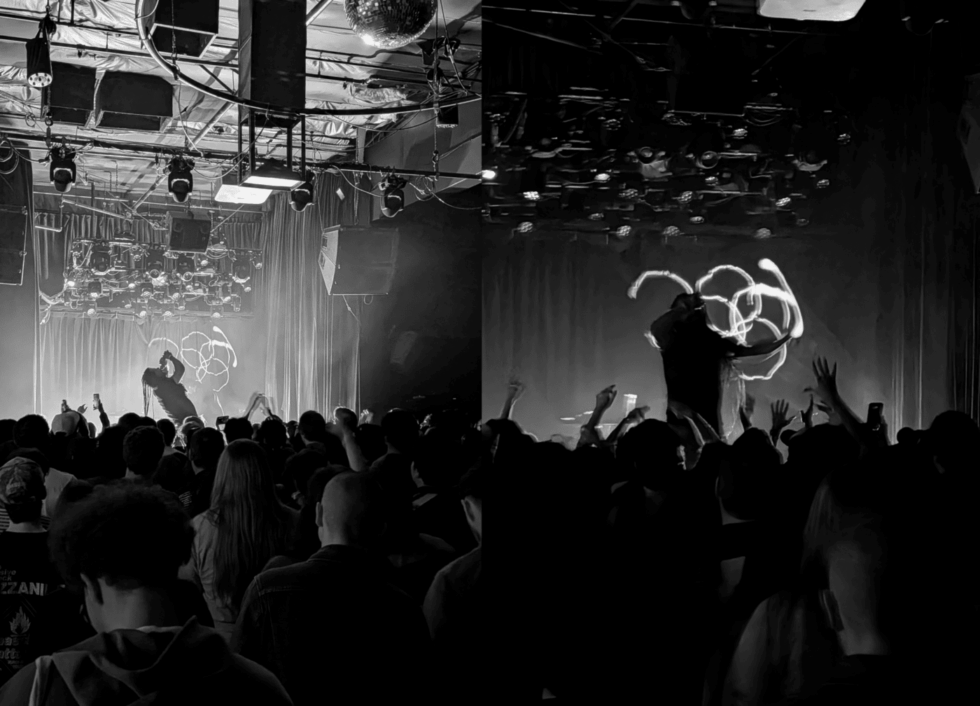
By Storm at The Echo, Los Angeles CA June 19, 2026
Review by DJ NDA, host of NDA Express
By Storm was a totally new experience for me. Although I had visited the Echoplex before for punk and rock shows, this was my first time at the Echo, the smaller, more intimate counterpart to its sister venue. Upon entering, I was greeted by poster-choked walls, TVs mounted above the bar promoting upcoming shows, and the venue’s aged, black interior. The audience was a mix of ages, with lots of black hoodies and tattoos.
By Storm, the experimental hip-hop duo of rapper Nathaniel “RiTchie” and producer Parker Corey, emerged following the death of Injury Reserve founding member Stepa J. Groggs in 2020 and the posthumous release of the group’s final album, By the Time I Get to Phoenix, in 2021. This concert was the LA stop on their My Ghosts Go Ghost album tour (Friday, June 19, 2026) and their first ever tour as By Storm. Needless to say, fans were excited.
It was the early hits of Injury Reserve on their second album, Floss, that put me onto this concert. I remember being a middle schooler who had just gained access to Spotify, discovering their hard-hitting classics, such as “S on Ya Chest,” “Oh Shit,” and “All This Money.”
I had heard that RiTchie and Parker had been touring with Jockstrap, sampling Black Country, New Road, and recording with the drummer of Black MIDI—all bands associated with the UK’s “Windmill Scene”—but they had yet to release a full album. This would be the ground on which they staked out a new creative identity. The two survivors of Injury Reserve seemed to be grappling with a lot of questions about what their new group would become. Was this their phoenix-esque “rise from the ashes”? A passing of the baton? How much of the album would be dedicated to honoring their roots, and how much of it would be dedicated to forging a new path forward?
Their first song, “Can I Have You For Myself?,” featured a forlorn sample of guitar and vocals looped repeatedly to the extent that it sounded like a tape recorder being rewound and
played through over and over again. The song was held together not by a beat but by RiTchie’s pleading lyricism, which served as a poetic spine, stringing the samples together with feel. Vocals were flexibly, but intentionally, timed to match the energy of the performance that night.
Can I have you all for me?
Can I have you for myself?
Can I have you?
Like at the Echoplex, there’s no barrier between the artists and the crowd at the Echo, and RiTchie played this to his advantage. He was very willing to engage with the audience as frontman, letting his hands pass over theirs, outstretched, as if he were a grace-giving prophet. Parker Corey stood in the back, facing his equipment, nodding along to the music and engaging minimally with the audience.
Their second song, “Dead Weight,” stood in stark contrast to “Can I Have You for Myself” with its sheer volume and intensity.
Don’t tell me I would or if I won’t
Don’t tell me, if I did all that, I’d share, that ain’t what I want
Don’t tell me I should or if I shouldn’t
Don’t tell me I can, but I don’t know if it look good or if it wouldn’t
I began to notice the weight of autotune on RiTchie’s voice and By Storm’s heavy low end. My body was shaking beneath the Echo’s sound system. Because Parker’s layering of samples is
so rough and misregistered, the bass immediately stands out (not like a bass guitar following the rhythm guitar while playing the root of the chord, effectively becoming “invisible”).
Funny enough, while By Storm tends to keep their creative process abstract and without elaboration, there appears to be a pretty simple explanation for why the bass is so heavy on My Ghosts Go Ghost in a Reddit AMA with the duo; Parker moved from a small apartment in Echo Park to a duplex in Phoenix with thick cement walls, allowing him to work without annoying his neighbors.
Their third song, “Grapefruit,” had a catchy lyrical hook that became a wonderful vocal stim later. All weekend, I would randomly drawl, “graaaaapefruuuuuit,” totally removed from any context of the Echo.
I let it rip me open, they barely blink too
The outside lookin’ somethin’ like grape
And the inside lookin’ somethin’ like grapefruit
RiTchie makes his ultra-catchy lyrical hooks even more so through his experimentation with voice. Rarely ever are his lyrics delivered in his regular speaking or interviewing voice. Most are delivered in strange, uncanny timbres—high falsettos or deep, booming basses—that stick to your unconscious in such a way that you find yourself parroting them back while driving or in the shower. In an interview with Huck magazine about By The Time I Get to Phoenix, RiTchie says, “I recorded all my stuff alone in a dark room, but this created a truth. I was trying to rap in new voices so I could get out of my head.”
By Storm played two songs from By the Time I Get to Phoenix, “Knees” and “Superman That.” At the concert, I didn’t realize that “Superman That” sampled “Athens, France” by Black
Country, New Road; Parker’s samples are so small that they are completely out of time and context. These bits of samples—looped continuously over longer drum loops to build larger, more substantive samples that compose the verses, choruses, and refrains of his production—are less than a second long and wildly strung together. Interview insights are necessary to discern the source of his samples.
The total fracturage and remixing of their source samples, along with the fact that most of their songs have no discernible time signature, allows By Storm to transcend any songwriting precedent, including their own. The raucous, rhythmic “bounce” of Injury Reserve is gone in favor of something far more experimental.
In By Storm’s entirely sample-driven production, there is so much sonic distance from the original source that its metaphorical and thematic concerns become completely absent as well. In effect, their songs only make reference to themselves. Their inspiration is implacable. Their songs’ meanings are absent in abstraction.
In interviews, it’s not uncommon that RiTchie isn’t able to provide an explanation for his lyrics either. That isn’t to say that the music is bad because it lacks a coherent explanation; it prods at something quite personal and unconscious. I doubt that “Superman That,” with lyrics such as “you can keep what you stitch until they peep now you reap what you sow,” has anything to do with Soulja Boy, “Athens, France,” or the lyric that “she flies to Paris, France, I come down in her childhood bed.”
The personal significance of By Storm to its members is also hard to place. Through interviews, you begin to get the sense that RiTchie and Parker Corey consider By the Time I Get to Phoenix (Injury Reserve’s last album) and My Ghosts Go Ghost ( By Storm’s first album) to be one liminal project in itself. It seems that the duo thinks fondly of their double video for the last
Injury Reserve song, “Bye Storm,” and the first By Storm song, “Double Trio.” Whether RiTchie and Parker consider By Storm to be a continuation of Injury Reserve or a totally “new thing” is debatable as well.
Whether My Ghosts Go Ghost is a response to any combination of personal and political events is really anyone’s guess. The album could be a reaction to Groggs’ death, COVID (and the fractured progression of a career in music as a result of social distancing), the resurgence of Black Lives Matter in response to the murder of George Floyd, the sudden death of RiTchie’s stepfather, or the birth of his son. It seems like RiTchie and Parker don’t know either. This “everything and nothing” approach manages to appeal to new fans while staying familiar with the old.
In any case, while the idea behind By Storm remains illusive, my experience of seeing them live was incredibly moving. By Storm continues to take the position that their projects tend to be much less conceptual pieces than what the court of public opinion has decided. RiTchie simply responds to Parker’s production, allowing associations to percolate from beneath the surface as they might in conversation, whether personal or political. But neither do RiTchie or Parker Corey think that anyone’s interpretation of the work is wrong. You can say that My Ghosts Go Ghost is about anything, but the better strategy might be to interpret it through Groggs’ last piece of advice, which was to “make cool shit,” which the duo stands by to this day.
By DJ NDA